
Fulfilling my desire for fresh, moist, chewy, multigrain
bread with a good crust has not been easy these past 6 years. My efforts have
been thwarted by multiple limitations in our local reality. Even though Niterói
is a pretty big city (about 500,000 people) and we sit just across the bay from
Rio de Janeiro, the variety of fresh breads found in local bakeries is pretty
limited. None of the bakeries near me are making anything like what I have in
mind.
The typical Brazilian so-called French style “pãozinho” (little
bread) and its cousin the longer baguette are wonderful if you like pure white
flour, super light and airy interiors with a thin, delicate outer crust. Many
bakeries do an outstanding job of making these little, delicately crusted,
bread clouds – and they are very popular.
Forgive me if I prefer a heartier, whole wheat chew in my bread. And when
I desire white flour bread I prefer it more Italian-style with a firm texture
and a thick, almost burnt crust.

Finding satisfying bread has been a bit of a conundrum.
Back in the early 1980s I lived in a hip(py) vegetarian housing
co-op in Lansing, Michigan. We made all our own bread (and yogurt, and tempeh,
and granola). So I am no stranger to making bread. I understand that bread
dough is alive and must be kept that way, treated with kindness, until placed
in the oven. Unlike the precise chemistry in cake baking, I know there is some
room to play with the proportions of ingredients in breads, and that gluten is generally
your friend (apologies to those who are intolerant).
Just after college, during that year of wondering what came
next, I worked the night shift in a family-owned Italian bakery. We made
hundreds of dozens of dinner rolls, baguettes, various loaves and various
specialty breads nightly.
These are the experiences, both personal and
professional, that I have brought to my task of unlocking the secrets of
successfully making bread in my home here in Brazil.

Bread making with locally available ingredients and in my
little Easy-Bake Oven, however, has been a journey.
In my experience, the obstacles to success pretty much come
down to two things: the flour here has a low protein count (which means it is
low in gluten) and a typical, basic, household oven cannot muster up the
necessary heat to get a good crusty crust. But I have finally overcome these
obstacles and am sharing my “solutions” in this post.
A note on my oven: we have your basic stove appliance found
all over the country in typical homes. It heats with gas and sells for about
R$600. It is a four burner, so some would see it as an “apartment” size stove
and strive for a 5 or 6 burner model for larger families. But in reality, most
families are stone broke, so this is about as much stove as they can afford.
 |
| Here's my oven, with some dough put to rise. Note I use a hang-on thermometer. The oven dial does not include temperature markings (not that I would trust them anyway). |
As is true with so many things here, while it may not be fancy,
it does the job. Well, in this case, the job of boiling or frying on the
stovetop. But it just doesn't get hot enough in the oven to make things like a toasted,
blistered pizza crust or a crispy bread loaf. There are definitely more robust
options on the market, but they tend to be much larger in size (thus not
fitting in our kitchen) and have larger price tags (thus not fitting in our
budget). As it stands, I am set on developing strategies for making our oven
work rather than living beyond our means.
Join me down here in regular people Brazil-land for some
tips on getting a decent sandwich loaf of multi-grain wheat bread from your run
of the mill oven. I think I have worked it out.
So the two things I want in my breads (correlated to the
above mentioned obstacles) is a good texture/shape and a crispy crust.
The way I have worked out the crispy crust thing is to (wait
for it) just let it go. It’s not gonna happen. I can force a hard baked crust,
but only by over cooking the loaf. I've tried splashing water into an iron pan
pre-heated on the bottom of the oven when putting the bread in. But the steam
it creates that is supposed to moisten and then crisp the crust just manages to
extinguish the oven flame and cut the heat altogether. Spritzing water onto the
surface of the loaf to coax a crust just produces a soggy mess that eventually
cooks, but never crusts. The oven is never hot enough. Ah well – I’m just
letting go… no homemade crispy crust bread out of my oven. Sigh. Moving on…
I have figured out the whole texture and “structural
integrity” thing; the gluten problem. The texture of my multi-grain bread
rocks!

After some serious searching, plus the repeated education of
a local natural foods store manager encouraging him to sell gluten, I can now
buy “farinha de gluten” (gluten flour, or ‘vital gluten’) to then add to my
locally available flours to increase the gluten content sufficient to create
the texture I need. I have never seen so-called “bread flour” on the shelves
here at grocery stores.
There is a nearby Italian bakery/sandwich/dessert shop that
sells imported “type 00” flour, which is essentially bread flour with a higher
protein content – perfect for pizza dough – but it is a bit expensive. If you
can find this imported “type 00” flour in your area, it is a solution in and of
itself if you are just using it (with little to no whole wheat or other flours
added).

So to make that perfect loaf here’s what you do. First, get
your hands on farinha de gluten (not “farinha com gluten” that is just regular
flour with a kick of gluten added - not the same). You will be adding about 5 –
6 teaspoons of gluten to the flour of each loaf (4 teaspoons if you’re just using
white flour). Second, and just as important, is to add an “autolyse” step into
your mixing process.
An autolyse (in bread making) refers to a resting period
just after the initial mixing of water and flour (and in our case the added
gluten) that gives the mixture time to hydrate. This step ramps up the
development of gluten (which depends on water) as well as allows time for the
flours to “self-digest” (break down a bit), making the whole-grain dough less
tacky to work with and ultimately light and chewy rather than tough.
The solution is in the biology and chemistry. Yay science!
Enough already – here is the recipe.
Multi-grain Sandwich Bread
This recipe is a modified version of one perfected by the
cooks/food scientists over at Cooks Illustrated. It was by reading their
materials that I learned about the value of an autolyse process, for which I am
grateful.
Makes one large loaf. Feel free to double the recipe – I cut
the original recipe in half because Luiz and I rarely have use for two large
loaves at any one time.
Ingredients
¾ cup (150 g) multi-grain mix (explained below)
1 cup (200 ml) warm water
1 ½ cups (225 g) white flour
¾ cup (100 g) whole wheat flour
5 teaspoons gluten (vital gluten or trigo de gluten)
3 Tablespoons molasses (melaço or “melado”) or honey (mel)
2 Tablespoons unsalted butter, melted (or you can use canola or soy oil)
2 teaspoons (5 g) active dry yeast (fermento biológico seco instantâneo)
1 teaspoon salt
½ cup seeds, like sunflower or sesame (optional)
1 cup (200 ml) warm water
1 ½ cups (225 g) white flour
¾ cup (100 g) whole wheat flour
5 teaspoons gluten (vital gluten or trigo de gluten)
3 Tablespoons molasses (melaço or “melado”) or honey (mel)
2 Tablespoons unsalted butter, melted (or you can use canola or soy oil)
2 teaspoons (5 g) active dry yeast (fermento biológico seco instantâneo)
1 teaspoon salt
½ cup seeds, like sunflower or sesame (optional)
Procedure


To make the multi-grain mix I use a couple of tablespoons
each: pearled barley (cevada, or “cevadinha”), wheat berries (trigo em grão),
whole oats (aveia) and bulgur/cracked wheat (trigo para kibe). You can use
whatever grains you like. (If I could find them I would use soy grits and
buckwheat groats rather than the barley and cracked wheat. But I have not seen
these here.) Boil the wheat berries and barley for about 35 minutes, or until
tender. Then add the oats for a couple minutes, then the cracked wheat. Remove
from heat and let it sit a few minutes. It should be a cooked but chewy mix.
Measure out your ¾ cup portion. Eat the rest with yogurt and a banana for
breakfast. J
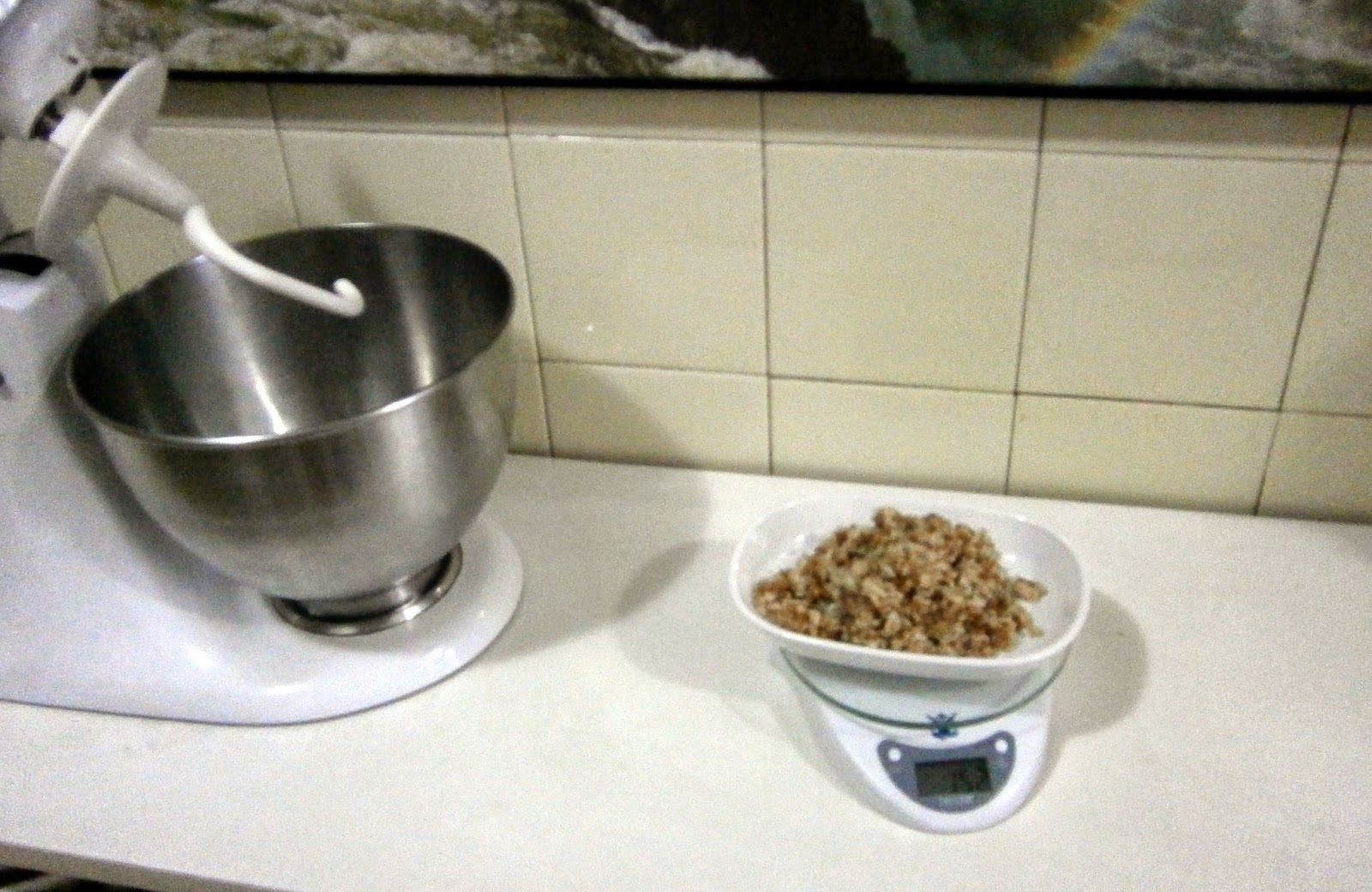

Place the prepared grain mix, water, sweetener and oil in the mixing bowl of your Kitchen Aid [I hope you have one. Or any strong stand mixer. Luckily I brought my 25 year old workhorse from the States. Without a machine to help you, prepare to knead by hand a good 15 minutes or longer. Longer kneading is also part of the success.]. Be sure it is not too
hot. Then stir in the yeast and let sit for 5 – 8 minutes until the awakened
yeast is foamy.

Meanwhile, sift together your flours and gluten. Feel free
to experiment with other tasty flours you have been missing since you moved here.
Do NOT add the salt just yet. It retards the yeast, so we will add it later.

When the wet mixture is nice an foamy, using the dough hook,
slowly mix in the flour mixture. Mix it up until well combined, about 2
minutes, but don’t lean in to the kneading process. Cover the bowl with plastic
wrap (I just wrap a tea towel around the stand mixer) and let it sit for 20
minutes. This is the autolyse step I described earlier. Don’t rush this. Let it
do its magic.


Now add the salt and knead on medium speed until the
still-wet dough clears the sides of the bowl, about 4 minutes. You will surely
need to add more flour to help stiffen the dough, but don’t go crazy. I like to
keep the dough a little more sticky than seems intuitive. But you may find
yourself adding a bunch of flour (a little at a time). Just go for it and try
not to overdo it.
When the dough seems about right (still sticky looking) continue to knead for 5 more minutes. Depending on the random turning motion of your dough ball in the mixer you may want to stop and rearrange the dough a couple of times just to be sure you are getting a thorough kneading. Add a bit more flour as needed (so to speak).
Once everything is perfect, transfer the dough to a floured surface and carefully knead in the seeds. Remember the dough is still alive and relying on you to treat it with care until you place it into the oven. Do not force yourself on it, tearing up the dough. Be gentle, but firm.
When the dough seems about right (still sticky looking) continue to knead for 5 more minutes. Depending on the random turning motion of your dough ball in the mixer you may want to stop and rearrange the dough a couple of times just to be sure you are getting a thorough kneading. Add a bit more flour as needed (so to speak).
Once everything is perfect, transfer the dough to a floured surface and carefully knead in the seeds. Remember the dough is still alive and relying on you to treat it with care until you place it into the oven. Do not force yourself on it, tearing up the dough. Be gentle, but firm.

Form the dough into a taut ball and place it into a large slightly
oiled bowl. Cover lightly and allow to rise, away from any drafts, until
doubled in size; about an hour.
Go do other stuff: make the bed, check your Facebook, do the
laundry, lay in a hammock and listen to Yo-Yo Ma on your iPod, whatever… Good
bread takes time.

Adjust your oven rack to the middle position. Heat oven to
375 degrees F (180 C). If you are using a bread pan, grease it slightly. If you
are going for the country-style big round loaf I suggest you put a pizza stone
or a super large clay pot into the oven and preheat it along with the oven
itself. The stone/clay helpers MUST be preheated. Do not pre-soak the clay pot
as you might have read in regards to other recipes. That’s a different thing.
Here we are using the pot to not just help create a dry crisp bottom on the
loaf, but also to help preserve the heat in the oven when you open it to put
the loaf in. Every degree counts!
If you are going with the big clay pot, prepare a large
sheet of parchment (papel manteiga) on a cooking tray, dusted with cornmeal
(fuba). Set aside. No need for the parchment if you are using a flat pizza stone. Just dust a pan to rest the dough on to rise.


Transfer your risen dough to a lightly floured surface and
punch it down (gently). If you are going with the loaf pan, fold it over itself
(in thirds) and pat it into a rectangle suitable in size to fit into the pan. (At this
point you can also roll the dough in oats for that all-over oats look. But I
find the oats I get are too tough.) Gently place it into the pan, cover lightly and let it rise again until almost
doubled, maybe 30+ minutes.

For the round loaf gently fold the dough over and then shape
it into a ball, tucking the sides under and pressing up into the center. Pull into
a firm ball but take care not to rip the dough. Place the ball onto the center
of the prepared, dusted parchment paper. Cover and let rise until almost
doubled.

This second rising is critical, but you also do not want to “over
proof” the dough, so even though you may get hypnotized by the magic of your
rising loaf, don’t let it rise for an hour or longer. It will reach for the
sky, but also probably over reach and then collapse when you handle it or when
it gets placed into the oven. You want height AND firm structural integrity. It
should be big, but not squishy - puffy - fragile.

Now either place your pan into the oven or carefully transfer your dough onto the pizza stone, or gently lift
your parchment carpet with even tension and place it into the preheated clay
pot – quickly placing it in the oven. Keep that Easy-Bake Oven door closed as
much as possible so as not to lose valuable heat.

Bake until internal temperature registers 200 degrees F
(about 95 C), about 30 - 40 minutes. You should have a nice brown crust. Do not over bake. Longer
might get you a darker crust, but it will also get you a thicker crust and a
dryer loaf. Remove from pan/pot and cool on a wire rack before slicing.
 |
| This bread has such terrific texture you can slice really thin slices and it holds together nicely. |
It works for me. Let me know how it goes for you. Your
advice and tips are appreciated.








 Posts
Posts


